Niche Research · Cixur Team · October 27, 2026 · 7 min read
How to Find a Profitable Etsy Niche: A Beginner's Guide
Every Etsy seller starts in the same place: staring at a blank shop and wondering what to sell. The temptation is to pick something you love, list it, and hope buyers arrive. Sometimes that works. More often, it leads to a quiet shop and a slow slide into doubt. A niche is not a guess. It is a small corner of the marketplace where a clear group of buyers wants something specific, and where you can offer it in a way that stands out. Finding that corner takes research, but the research itself is straightforward once you know what to look for. This guide walks through it step by step, in plain language, so a complete beginner can follow along and finish with a shortlist worth testing.
What a niche really is
A niche is narrower than a category and wider than a single product. "Home decor" is a category. "Printable wall art for nurseries" is a niche. "Hand-poured candles" is a product line inside a niche that might be "scented candles for relaxation gifts." The narrower you go, the clearer your buyer becomes — and the clearer your buyer is, the simpler every later decision gets: what to photograph, what words to put in your title, what price feels fair.
Beginners often worry that narrowing down means losing buyers. In practice the opposite happens. A broad shop speaks to everyone and connects with no one. A focused shop tells one group of buyers, clearly, "this was made for you." That clarity is worth more than a large audience that scrolls past.
Start with buyers, not products
Good niche research starts with a person, not a product idea. Picture one buyer in detail. What occasion are they shopping for? A wedding, a new baby, a house move, a gift for a friend? What problem are they trying to solve — a room that feels bare, a planner that never quite fits, a gift that feels personal rather than generic? What words would they type into search when they are ready to buy?
Write down three or four buyer sketches before you look at any data. This matters because data without a buyer in mind is just noise. When you know who you are serving, every listing you study teaches you something: this title speaks to brides, that one speaks to new parents, this shop's reviews mention gifting again and again. You start to see patterns instead of products.
Read demand the honest way
Demand means buyers are actively looking. You can sense it in several ways. Listings in a niche gather favorites steadily. Shops in the niche collect reviews at a healthy pace. New listings keep appearing, which tells you sellers believe buyers are there. Search interest rises around occasions and seasons tied to the niche.
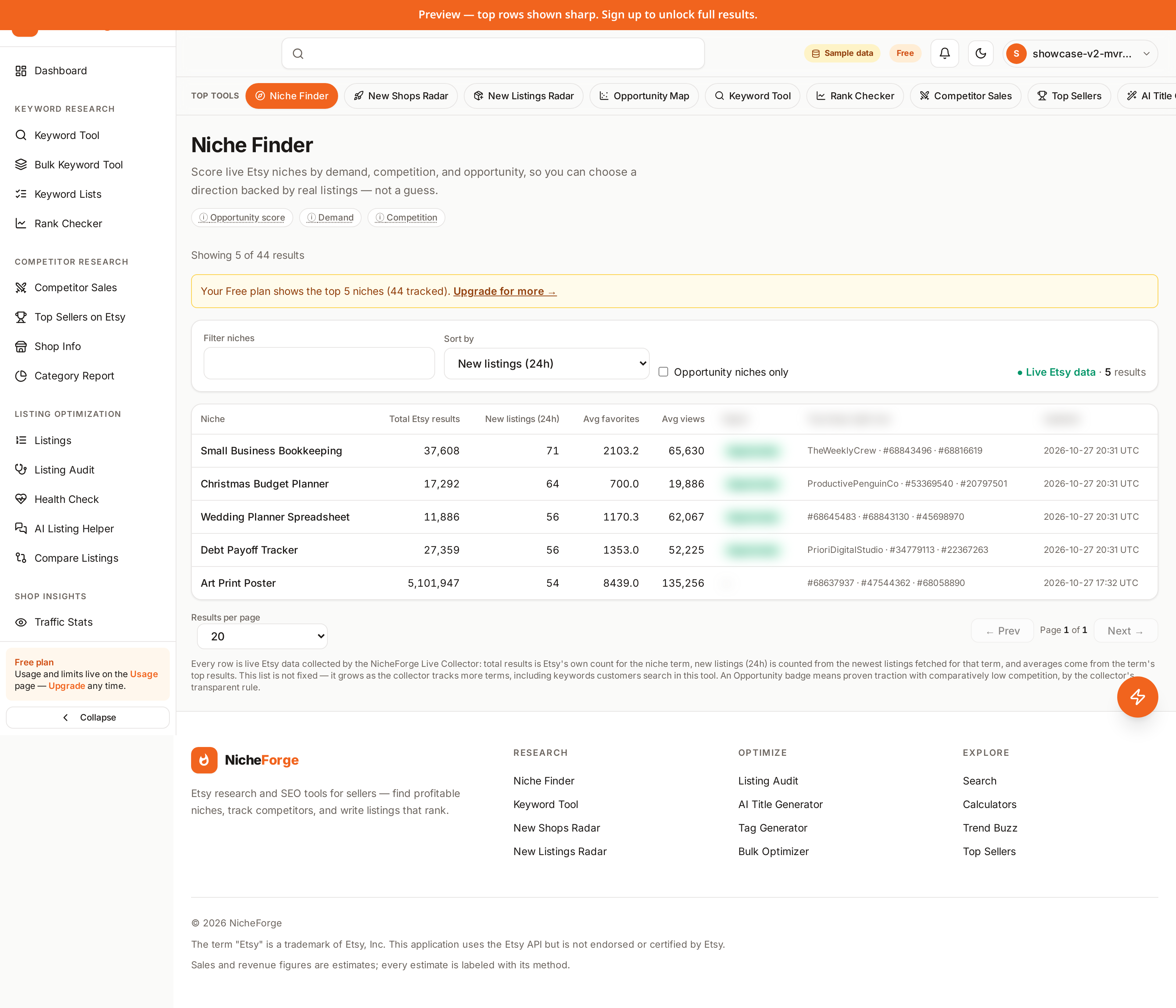
Be careful with one trap: a niche can look busy because sellers are busy, not because buyers are. Lots of listings with little traction is a warning sign, not a green light. Look for the combination that matters — buyer signals like favorites and reviews, alongside fresh seller activity. When both move together, demand is real. The Niche Finder scores niches on demand, competition, and opportunity from live listings, which gives you a structured place to compare candidates instead of relying on gut feeling.
Read competition without fear
Competition scares beginners, but it is also information. A niche with no competition at all usually has no buyers either. The question is never "is there competition?" but "what kind of competition, and can I stand apart from it?"
Open the strongest listings in a niche and study them like a buyer would. Are their photos clear and bright? Do their titles read naturally, or are they stuffed with keywords? Do their descriptions answer the questions a buyer would ask before purchasing? Do reviewers mention the same wishes or complaints again and again? Every gap you find — a missing size, a confusing description, photos that hide the product — is an opening. Competition you can out-serve is not a wall. It is a map of what buyers already want and are not yet getting. Compare the leaders with the Top Sellers view, and check how crowded a whole category is with the Category Report.
Check the money side before you commit
A niche can be popular and still be a poor business if the numbers do not work. Before you commit, sketch the money side on paper. What do comparable listings sell for? What are your material and production costs? What fees apply on each sale, and what is left after them? What would shipping cost, and who pays it? Run those figures through the Calculators to see fees, profit, and margin for a listing at a realistic price. If the margin only works at a price buyers will not pay, the niche is not profitable for you — even if it is profitable for someone with different costs. That is a useful answer, not a failure. It frees you to move to the next candidate on your list.
Build a shortlist, then test it
Never bet your shop on a single niche idea. Build a shortlist of three to five candidates, score each one on demand, competition, and margin, and rank them honestly. Then test the winner small: a handful of listings, photographed well, titled with the words buyers actually type, described clearly. Watch what happens over the following weeks. Which listings get favorites? Which search terms bring views? Which questions do buyers ask? Testing beats debating. A small, real test tells you more than another week of reading about niches.
Use the Keyword Tool while you test. The words buyers type are the bridge between your listings and their searches, and the tool shows you related terms drawn from real listing tags, so your titles and tags can speak the buyer's language from the start.
Common beginner mistakes
Three mistakes catch beginners more than any others. The first is choosing a niche because you personally love the product, without checking whether buyers search for it — love is a fine reason to make something, but it is not evidence of demand. The second is copying the market leader outright: same style, same photos, same price. Buyers have no reason to choose the copy over the original, and search has no reason to rank it above. The third is spreading across many unrelated niches at once, so no part of the shop builds authority or a recognizable style. Pick one direction, serve it well, and let the results tell you whether to deepen it or pivot.
The research habit that keeps you honest
Niches shift. Occasions pass, trends rise and fade, new sellers arrive. The sellers who last are not the ones who picked perfectly once. They are the ones who check the market regularly: a glance at the New Shops Radar and New Listings Radar to see what is fresh, a look at Trends to catch rising interest early, and a periodic re-check of their own niche scores. Make research a short weekly habit, not a one-time event, and your shop will move with the market instead of behind it.
Conclusion
Finding a profitable Etsy niche is not magic and it is not luck. It is a repeatable process: picture the buyer, check demand honestly, study competition for gaps, run the money side, shortlist, and test small. Do that, and you will make decisions with evidence instead of hope. Your first niche may not be your forever niche, and that is fine — every round of research sharpens your judgment for the next one. Start today, start small, and let real buyer signals guide you.
Try it free — open the Niche Finder and score your first niche idea today.
Get started free →The term "Etsy" is a trademark of Etsy, Inc. This application uses the Etsy API but is not endorsed or certified by Etsy.
More from News
- Etsy Keyword Research: Choosing Keywords That Match Buyers (Keyword Research · 6 min)
- Reading Demand vs Competition for an Etsy Niche (Niche Research · 6 min)
- Etsy Listing SEO Checklist: Titles, Tags, Descriptions (Listing SEO · 6 min)
- Spotting New Etsy Shops and Trends Early (Trends · 7 min)